
|
| Catalog Number | Size | Price (USD) | Shopping Cart |
|---|---|---|---|
| RA20001 | 50 ul | $155.00 | Buy Now | Add to Cart |
| RA20001 | 150 ul | $368.00 | Buy Now | Add to Cart |
Type: Rabbit IgG
Applications: IHC
ICC=Immunocytochemistry; IF=Immunofluorescence; IHC=Immunohistochemistry; WB=Western blotting; FC=Flow Cytometry; IP=Immunoprecipitation; E=ELISA; NB=Neutralization of Bioactivity; FACS; All Fluorecent Images;
Species Reactivity: M; R
B=Bovine; Ca=Cat; Ch=Chicken; GP=Guinea Pig; H=Human; M=Mouse; P=Porcine; Pr=Primate; R=Rat; Rb=Rabbit; Ze=Zebrafish; na
Format: Whole serum - liquid
Immunogen: KSCMDRGMRNLLPDDGPRQE
Description/Data:

Three types of opioid receptors have been cloned -- mu, delta, and kappa. Opioid receptors are seven transmembrane G-protein coupled receptors. They share a high degree of homology and are most divergent at the N- and C-termini. Activation of mu opioid receptors leads to a decrease in neuronal excitability. Several C-terminal splice variants have been identified for the Mu Opioid Receptor (MOR1) including MOR1C. These splice variants appear to differ in their pharmacological selectivity as well as their membrane trafficking.
Related Reagents to Consider:
Pain and Inflammation Antibodies
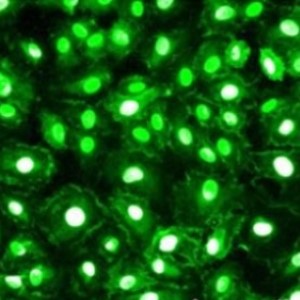
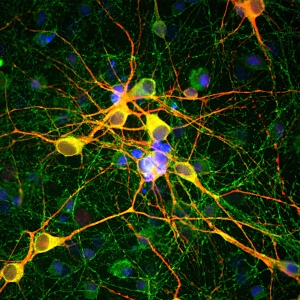
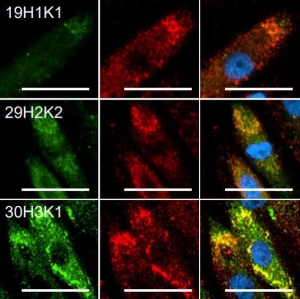
Image: A-D-Staining of Differentiated Stem Cells. D3 ES cells were maintained in serum/LIF/ME induced self-renewal conditions (undifferentiated cells, D3). Upon treatment with 1 µM RA they undergo differentiation (dD3). Cells were fixed and permeabilized. Treatments were followed by overnight incubation with polyclonal MOR-1 (C-terminus, 1:2500)