
Tested, Characterized and Research Ready
Catalog NumberSizePrice (USD)Shopping Cart
CH22101100 ul$275.00Buy Now | Add to Cart
 
Type: Chicken IgY
 
Applications: IF; FC
ICC=Immunocytochemistry; IF=Immunofluorescence; IHC=Immunohistochemistry; WB=Western blotting; FC=Flow Cytometry; IP=Immunoprecipitation; E=ELISA; NB=Neutralization of Bioactivity; FACS; All Fluorecent Images; ; HPLC=High Performance Liquid Chromatography; FPLC=Fast Protein Liquid Chromatography
Species Reactivity: H; M; R
B=Bovine; Ca=Cat; Ch=Chicken; GP=Guinea Pig; H=Human; M=Mouse; P=Porcine; Pr=Primate; R=Rat; Rb=Rabbit; Ze=Zebrafish; na
Format: liquid
 
Immunogen: recombinant alpha-internexin
 
Description/Data:

alpha-internexin is a ~66 kDa Class IV intermediate filament originally discovered as it copurifies with other neurofilament subunits. It is related to but distinct from the better known neurofilament triplet proteins, NF-L, NF-M and NF-H, having similar protein sequence motifs and a similar intron organization. It is expressed in large amounts early in neuronal development, but is downregulated in many neurons as development procedes. Many classes of mature neurons contain alpha-internexin in addition to NF-L, NF-M anbd NF-H. In some mature neurons alpha-internexin is the only neurofilament subunit expressed. Antibodies to internexin are therefore unique probes to study and classify neuronal types and follow their processes in sections and in tissue culture. In addition the very early developmental expression of alpha-internexin means its presence is an early and convenient diagnostic feature of neuronal progenitors cells and other cell committed to the neuronal lineage.

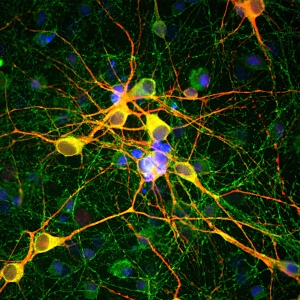
Image: Mixed neuron glia cultures stain with chicken Neurofilament alpha-internexin/NF66 (red) and counterstained with Coronin 1a, (green) which is an excellent marker of microglia and lymphocytes. The chicken internexin antibody is an excellent marker of neuronal processes in these cultures.

Note: The serum can be diluted to 1:1,000 and higher for immunofluorescence staining and 1:10,000 and higher for western blotting. On western blots use a brain or spinal cord homogenate and look for a major band at SDS-PAGE apparent molecular weight of 66 to 68kDa, depending on the species. The human protein runs at ~68kDa, while rat, mouse and other species run at ~66kDa. Minor bands at ~150kDa are probably covalent dimers, and bands at ~50kDa represent a-internexin breakdown products.

More Links:

Neurofilament alpha-internexin/NF66 Antibody-Mouse

Neurofilament alpha-internexin/NF66 Antibody-Rabbit        

Neurofilament or NF Antibodies                                 

Neuron-Glial Expressed Proteins

Axon Growth and Guidance Antibodies

Axon Growth and Guidance Proteins

Neural Progenitor Markers                                       

Primary Neurons and Astrocytes-Primary human, rat and mouse neurons and astrocytes by Category

Stem Cell Research Reagents

Image: Western blot of extract of rat brain stem crude extract stained with chicken Neurofilament alpha-internexin/NF66, showing a single strong clean band at ~66kDa. Protocol on datasheet.