
Catalog NumberSizePrice (USD)Shopping Cart
MO22108500 ul$195.00   $225.00Buy Now | Add to Cart
 
Type: Mouse IgG
 
Applications: IF; WB
E=ELISA; FC=Flow Cytometry; ICC=Immunocytochemistry; IF=Immunofluorescence; IP=Immunoprecipitation; IHC=Immunohistochemistry; SE=Sandwich ELISA; WB=Western blotting; NB=Neutralization of Bioactivity; FACS; FPLC=Fast Protein Liquid Chromatography; GF=Gravity Flow; BSM=Biosactive Small Molecule or Peptide; HPLC=High Performance Liquid Chromatography; TPE=Targeted Protein Expression; AC=Adherent Cell Assays; NAC=Non-adherent Cell Assays; CDM=Cell Differentiation Media; BSC-CM5= Biacore Sensor Chip CM5; FM=Fluorescent Micsroscopy; ; ; ; ; ; ; ; ; ;
Species Reactivity: H; M; R
B=Bovine; Ca=Cat; Ch=Chicken; D=Dog; EQ=Equine; GP=Guinea Pig; H=Human; M=Mouse; P=Porcine; Pr=Primate; R=Rat; Rb=Rabbit; Y=Yeast; Xe=Xenopus; Ze=Zebrafish; ; ; ; NA-Not Applicable; STP=Step-Tactin Proteins; All
Format: Cell Culture Fluid - liquid
 
Immunogen: Mice were injected with yeast nuclear preparations and hybridomas were screened by immunofluorescence on yeast cells and by western blotting on yeast protein homogenates.
 
Description/Data:
Picture

The Nop1p protein is 327 amino acids in size (34.5kDa), is essential for yeast viability, and is localized in the nucleoli (1). The systematic name for S. cerevisiae Nop1 is YDL014W, and it is now known to be part of the small subunit processome complex, involved in the processing of pre-18S ribosomal RNA. Nop1p is the yeast homologue of a protein apparently found in all eukaryotes and archea generally called fibrillarin. Fibrillarin/Nop1p is extraordinarily conserved, so that the yeast and human proteins are 67% identical, and the human protein can functionally replace the yeast protein.

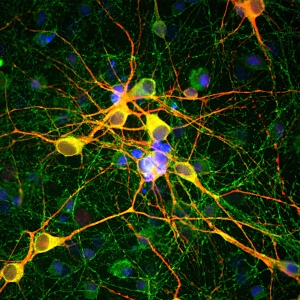
Image: Human SH-SY5Y cells stained with Fibrillarin/Nop1p  showing prominent specular nucleolar staining. The nuclei are counter stained with blue DAPI DNA stain, so these spots appear very pale blue. Cells are also stained with Neurofilament NF-H.

This protein lacks the RGG rich N-terminal extension but is clearly homologues to the other sequences throughout all of the fibrillarin domain. The 3D structure of this molecule has been determined and shown to consist of 2 extended b-sheets flanked by 4 a-helixes (Medline link). Patients with the autoimmune disease scleroderma often have strong circulating autoantibodies to a ~34kDa protein which was subsequently found to be fibrillarin. Recent studies show that knock out of the fibrillarin gene in mice results in embryonic lethality, although mice with only one functional fibrillarin/Nop1p gene were viable (3). This antibody is becoming widely used as a convenient marker for nucleoli in a wide variety of species (e.g. 4-6).

1. Ochs RL, Lischwe MA, Spohn WH, Busch H. Fibrillarin: a new protein of the nucleolus identified by autoimmune sera. Biol Cell 54:123-133 (1985).

2. Aris JP and Blobel G. Identification and characterization of a yeast nucleolar protein that is similar to a rat liver nucleolar protein. J. Cell Biol. 107:17-31 (1988).

3. Newton K, Petfalski E, Tollervey D, Caceres JF. Fibrillarin is essential for early development and required for accumulation of an intron-encoded small nucleolar RNA in the mouse. Mol Cell Biol. 23:8519-8527 (2003).

4. Tyagi S and Alsmadi O. Imaging native beta-actin mRNA in motile fibroblasts. Biophys J. 87:4153-62 (2004).

5. Paeschke1 K, Simonsson T, Postberg J, Rhodes D, Lipps H-J. Telomere end-binding proteins control the formation of G-quadruplex DNA structures in vivo Nature Structural & Molecular Biology 12, 847-854 (2005)

6. Vermaak D, Henikoff S, Malik HS. Positive selection drives the evolution of rhino, a member of the heterochromatin protein 1 family in Drosophila. PLoS Genetics 1:96-108 (2005).

Picture[2]

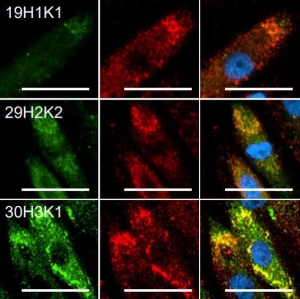
Image: Strip blots of yeast protein extracts stained with the indicated Fibrillarin/Nop1p and related markers.