
Catalog NumberSizePrice (USD)Shopping Cart
GP1410050 ul$215.00Buy Now | Add to Cart
GP14100150 ul$475.00Buy Now | Add to Cart
P14100100 ug Blocking Peptide$95.00Buy Now | Add to Cart
 
Type: Guinea Pig IgG
 
Applications: IHC
ICC=Immunocytochemistry; IF=Immunofluorescence; IHC=Immunohistochemistry; WB=Western blotting; FC=Flow Cytometry; IP=Immunoprecipitation; E=ELISA; NB=Neutralization of Bioactivity; FACS; FM=Fluorescent Micsroscopy; ; FPLC=Fast Protein Liquid Chromatography; GF=Gravity Flow; HPLC=High Performance Liquid Chromatography; TPE=Targeted Protein Expression; ; ; AC=Adherent Cell Assays; ; ; NAC=Non-adherent Cell Assays; ; ; BSC-CM5= Biacore Sensor Chip CM5;
Species Reactivity: H; R
B=Bovine; Ca=Cat; Ch=Chicken; D=Dog; EQ=Equine; GP=Guinea Pig; H=Human; M=Mouse; P=Porcine; Pr=Primate; R=Rat; Rb=Rabbit; Y=Yeast; Xe=Xenopus; Ze=Zebrafish; ; ; ; NA-Not Applicable; STP=Step-Tactin Proteins
Format: Whole serum - liquid
 
Immunogen: YTGSLKPEDAEVFKDSMVPGEK
 
Description/Data:
Picture

VR1 (vanilloid receptor 1) is a channel activated by capsaicin, the pungent ingredient in hot peppers. It was isolated from sensory neurons. Sequence analysis suggests that VR1 has six transmembrane domains and intracellular N- and C-termini. It shares structural similarities with the family of putative store-operated calcium channels. VR1 is expressed by nociceptive sensory neurons. It is activated by noxious heat and is thought to function as transducer of noxious thermal stimuli.

Customer Data and Publications on VR1-C

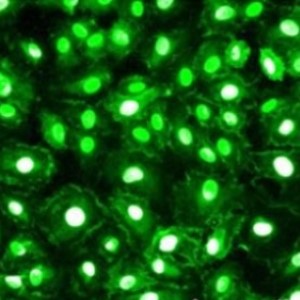
TRPV1-C IHC and Human Epidermis

Picture[3]

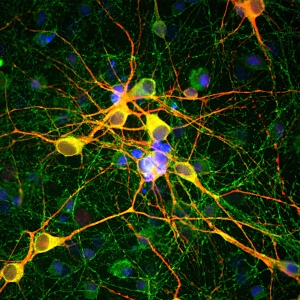
Image: VR1-C staining of rat dorsal horn (dilution 1:100).

Picture[2]

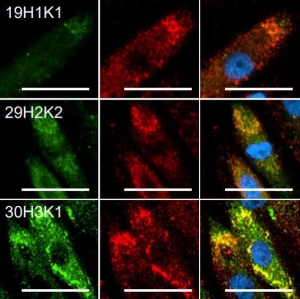
Images: (J Dent Res 85(1):49-53, 2006) : Evaluation of the expression patterns of TLR4 and CD14 in trigeminal sensory neurons. White arrows depict examples of neurons expressing both markers for each row of three images, and yellow arrows depict examples of neurons that express one but not both markers. Human trigeminal neurons were evaluated for co-localization of TLR4 (Panels A,D), CD14 (Panel B), with a marker for the capsaicinsensitive subclass of nociceptors (TRPV1, Panels B,C for TLR4 and Panels K,L for CD14), or a marker of myelinated sensory neurons (N52, Panels Figure 1. Evaluation of the expression patterns of TLR4 and CD14 in trigeminal sensory neurons. White arrows depict examples of neurons expressing both markers for each row of three images, and yellow arrows depict examples of neurons that express one but not both markers. Human trigeminal neurons were evaluated for co-localization of TLR4 (Panels A,D), CD14 (Panel J), with a marker for the capsaicinsensitive subclass of nociceptors (TRPV1, Panels B,C for TLR4 and Panels K,L for CD14), or a marker of myelinated sensory neurons (N52, Panels E,F). Rat trigeminal neurons were evaluated for co-localization of TLR4 with TRPV1 (Panels G-I) and CD14 with TRPV1 (Panels M-O). The addition of blocking peptide or the deletion of primary or secondary antisera produced a complete loss of signal in both the human and rat tissues. Scale bar is 100 um for Panels A-F and J-L, and 200 um for Panels G-I and M-O. Rat trigeminal neurons were evaluated for co-localization of TLR4 with TRPV1 (Panels G-I) and CD14 with TRPV1 (Panels M-O). The addition of blocking peptide or the deletion of primary or secondary antisera produced a complete loss of signal in both the human and rat tissues. Scale bar is 100 um for Panels A-F and J-L, and 200 um for Panels G-I and M-O.