
- Product Reviews
Leave a review for this product and you could be eligible for a $10 Starbucks gift card.
- Product Publications
Product Publications
If you've used this product in a publication, let us know. Email david@neuromics.com, with the publication details and you could be eligible for an Amazon gift card.
- Related Products
Related Products
Images
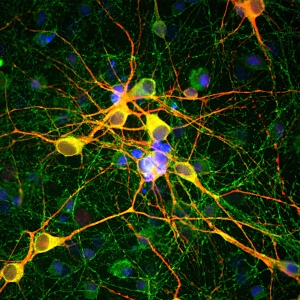
Immunofluorescent analysis of mouse hippocampus section stained with goat pAb to GFAP, GT22107, dilution 1:5,000 in green, and costained with mouse mAb to FOX3/NeuN in red. The blue is Hoechst staining of nuclear DNA. The GFAP antibody stains the network of astrocytic glial cells, while the FOX3/NeuN antibody specifically labels nuclei and proximal perikarya of neurons.
Western blot analysis of brain lysates from different species using goat pAb to GFAP, GT22107, dilution 1:5,000 in green: [1] protein standard (red), [2] rat cortex, [3] rat cerebellum, [4] mouse cortex, [5] mouse cerebellum, [6] cow cortex, and [7] cow cerebellum. Strong band at about 50 kDa corresponds to GFAP protein. Smaller proteolytic fragments of GFAP are also detected on the blot.