



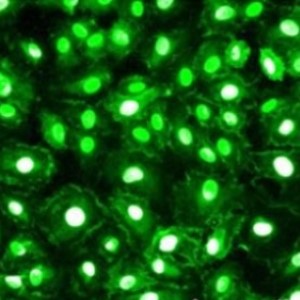

Over the past few years, researchers from Dartmouth have utilized our GFP-expressing U87 MG cells (cat. TR01-GFP) in surgical imaging research. They have been using the cells to evaluate various contrast agents for fluorescent-guided surgery by implanting our cells in mouse models. Last week, they published another study with fascinating results.
In their initial paper, released last year, the researchers identified TMR-PEG1k as the preferred contrast agent when compared with others. Then, earlier this year, the same group released a study highlighting the need for standardized methods to study contrast agents.
Image: Neuromics GFP Expressing U87 MG Cells were incubated with two potential contrast agents in surgical research.
In this week’s research, the investigators developed a near-infrared version of TMR-PEG1k to address some of the agent's shortcomings. Being in the visible regime, TMR-PEG1k is excellent for superficial tissue, but doesn’t allow for subsurface penetration, unlike a near-infrared agent. Therefore, the researchers developed a cyanine 7 version of the agent as an alternative.
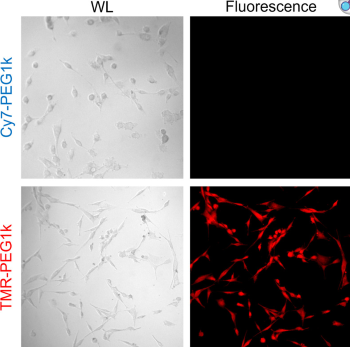
However, the cyanine 7 version of the agent was unsuccessful. It does not retain the same favorable properties of TMR-PEG1k and is therefore not a practical option for fluorescent-guided surgery. Check out the full study here.
This series of publications demonstrated the value of using labeled cells. They offer unique capabilities in so many cell models. Neuromics is proud to be a hub for GFP and RFP expressing human cell options, with many primary cells, cell lines, and iPSC-derived cell options. Furthermore, we can transfect and label any cell type of interest. Contact us if you have any questions.