
Our Neurons Help Investigate the COVID-19 Virus
Just last month, we shared some neuroblastoma research using our Primary Human Neurons (cat. HNC001). Well, it didn't take long for our neurons to remind us about their extensive abilities and get back in the spotlight.
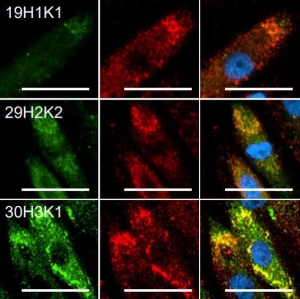
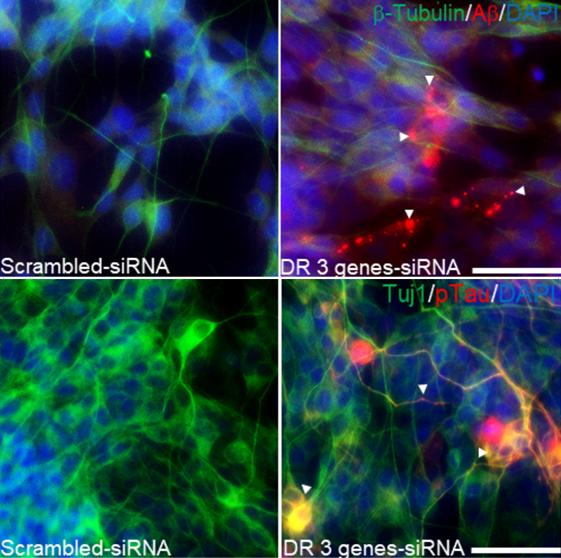
Earlier this month, researchers at the University of Maryland School of Medicine released preliminary findings demonstrating a link between COVID-19 and Alzheimer’s disease. Using human primary neurons provided by Neuromics, the investigators infected the cells with SARS-CoV-2 and saw the infection created an Alzheimer's-like neuropathology in the formerly healthy neurons.
Image: "Analysis of the effect of siRNA mediated individual or combined knockdown of the top 3 downregulated genes, GJA8, CryAA2 and PSG6, on the AD infectious etiology gene signature in primary human neurons. Cellular A aggregation (top row) and cellular p-Tau deposition (bottom row). AB Aggregate and p-Tau accumulation in the cytoplasm or neuronal axon are indicated by white arrowheads. Scale bar, 50 µm."
This effect on primary neurons translated to other donor neuron tissues as well, with the scientists continuing to find an Alzheimer’s-like neuropathology in healthy individuals and an aggravated Alzheimer’s neuropathology in Alzheimer’s patients. We encourage you to check out the full publication here.
More Research Releases Using Our Bio-Reagents
Last week, we highlighted two new publications using Neuromics fetal bovine serum (FBS). Well, it took no time for our bio-reagents to appear in newly released publications again. Three more publications featuring Neuromics products were published.
In the first study, scientists at the University of Minnesota cultured our human colorectal cancer associated fibroblasts (CAFs) (cat. CAF115) in liver cancer research. The investigators used various cell and mouse models to explore how CAFs are activated to promote metastasis. Read the complete publication here.
The second citation focused on a researcher at Middle East Technical University in Ankara, Turkey, utilizing Neuromics type I rat tendon collagen (4 mg/ml) (cat. TY002) to build a 3D organoid breast cancer model. You can learn more here.
Introducing AlphaBioCoat Precoated Products
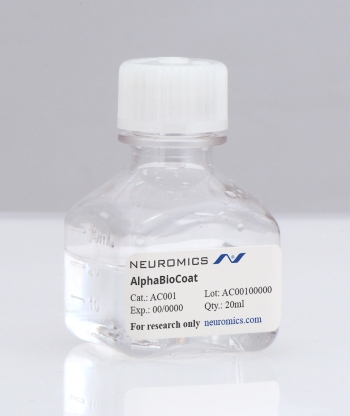
Neuromics has just introduced cell culture flasks, plates, and dishes precoated with our popular coating solution, AlphaBioCoat (cat. AC001). These products make plating cells easier than ever. Just grab your precoated product, wash it with PBS, and you're ready to plate. We encourage you to continue reading to learn about all our options, including various sizes and specifications.
AlphaBioCoat solution is a collagen based reagent that helps accelerate cell attachment and growth. We highly recommend its use with all of our many human cell types, whether plating from frozen or transferring the cells. Furthermore, the vast majority of publications using our human cells utilized AlphaBioCoat in their projects. You can check out our human cells and the publications using them here.
Precoated flasks, plates, and dishes all have a uniform and consistent application of AlphaBioCoat. They are aseptically processed and are non-pyrogenic. Additionally, all varieties are sold in packs of 10, shipped at room temperature, and can be stored for up to 6 months at 2-30°C.
Our Primary Human Neurons Enable Discoveries
Our primary human neurons (cat. HNC001) have been busy lately, continuing to become one of our most popular and versatile products. Earlier this month, Japanese researchers published their findings when creating 3D brain-like spheroids containing our primary human neurons. Their results suggest the spheroids mimic in vivo conditions and are suitable for use as an in vitro neurological disease model. Check out the publication for yourself here.
Since the beginning of 2022, our neurons have been cited a number of times spanning various research areas. They were used by researchers to suggest a link between the COVID-19 virus and Alzheimer's disease (lean more here). Additionally, investigators published findings (see here) using the neurons to find a potential therapeutics target for neuroblastoma.
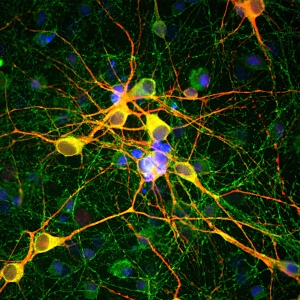
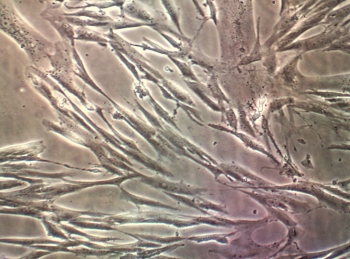
Image: Neuromics primary human neurons in culture.
Our neurons are just one of many reliable and research proven human cell types and lines we offer. We encourage you to explore all our human cells and the many citations using them.
Out of Matrigel? Check Out Our Collagel Hydrogels
Neuromics offers a large selection of tools for cell culturers, and we want to make sure you're aware of all of them. With Matrigel hard to find at the moment, we thought it'd be a great time to mention that our Collagel Hydrogels are in stock and ready to be used as a substitute for Matrigel.
Using our Type I Rat Tendon Collagen as the core ingredient, we have created a special formulation that creates a gel. Like Matrigel, our Collagel Hydrogels build a strong basement membrane for both 2D and 3D cell cultures. In your model, these hydrogels match the softness of the body's tissue and will not break or tear apart easily when stretched.
Image: Primary hepatocyte culture in 3D model using our Collagel Hydrogel.
We use Neuromics' Collagel Hydrogels in our lab when preparing our own 3D models. This includes our 3D Human Blood-Brain Barrier Model, which was just featured in Alzheimer's Disease research published this week (check it out here).
Read more to check out all of our hydrogels...
Neuromics Cells and Diabetes Research
To show appreciation to our customers, Neuromics enjoys highlighting research utilizing our products. Additionally, the results show that our reagents are truly research proven, as we often claim. In the past week alone, two articles have been published looking into complications related to diabetes that use human cells from Neuromics.
In the first publication, a group of scientists from Poznan University of Medical Sciences utilized our human retinal endothelial cells (HREC) (cat.# HEC09) in their diabetic retinopathy research. Diabetic retinopathy is caused by the senescence of HREC resulting from exposure to high levels of glucose in the blood. Using our HREC, these researchers showed that Sulodexide, a drug composed of a mixture of low molecular-weight heparin and dermatan sulphate, slows down the senescence of HREC in high glucose environments. In addition to our HRECs, the researchers used Alphabiocoat solution (cat.# AC001), ENDO-growth media (cat.# MED001), and cell detachment solution (cat.# ADF001) from Neuromics in the process of plating and culturing the cells.
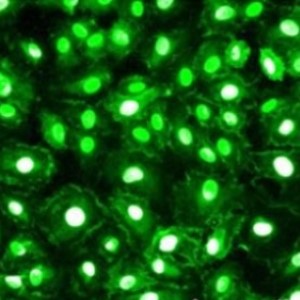
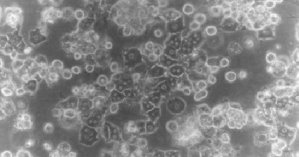
Image: Human retinal microvascular endothelial cells in culture
Read more to learn about the second publication...
Energize Your Cell-Based Assays
Collagen is a fibrous protein found in the extracellular matrix and connective tissue. The most common form of collagen is type I and is most prevalent in bone, tendon and skin. It consists of 3 intertwined coiled subunits: 2 x α1 (I) chains and 1 x α2 (I) chain. Each chain contains 1050 amino acids wound tightly around one another in a characteristic right-handed triple helix. The triple-helical structure of collagen arises from unique abundance of the amino acids in collagen appear in a characteristic repeating motif Gly-X-Y, where X is usually proline and Y is usually hydroxyproline.
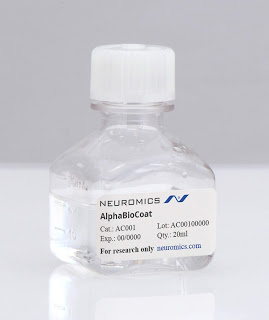
AlphaBioCoat Solution (AC001) is a biocompatible complex of extracellular matrix binding solution that is supplemented with growth factors. It helps accelerate cell attachment and cell growth. AC001 is the premium version of our Smooth Coat Solution (SC300).
Human Brain Cells
When researchers are considering using our human brain cells, they often voice concerns about growth. In order to address these concerns, we explain that we have optimized our media and coatings in order to meet their assay needs.
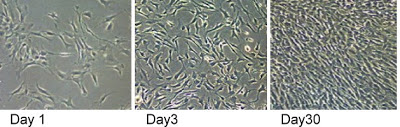
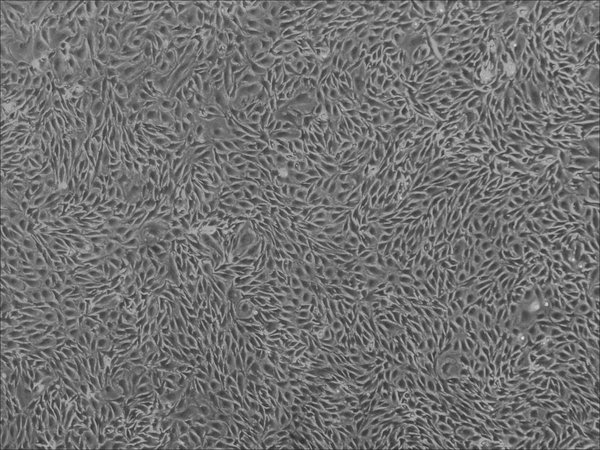
To the right, we have an example of how our human brain pericytes grow over time. Clearly, growth will not be a concern.