
More Blood-Brain Barrier Research
We are always excited to showcase innovative publications utilizing our reagents. We take immense pride in providing researchers and professionals with reliable and consistent products that unlock new possibilities in their fields. Today, we delve into another new study using some of of our primary human brain cells.
Researchers from the University of Nottingham have released two new publications using our primary human brain microvascular endothelial cells (cat. HEC02), brain pericytes (cat. HMP104), and brain astrocytes (cat. HMP202) to build an in vitro blood-brain barrier (BBB) model. Last week, we highlighted the first publication, where the impact of exposure to Substance P (SP) on the BBB was evaluated. You can check out the blog post to learn more.
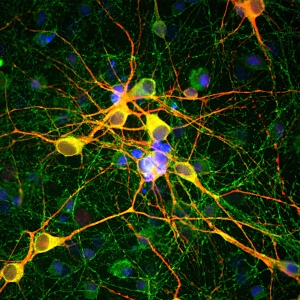
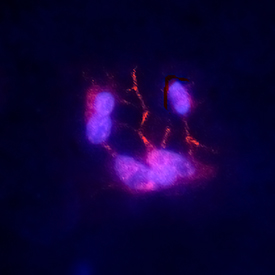
Image: Astrocytes stained with S100 beta.
Then, to our pleasant surprise, we saw the researchers cited our cells in another BBB related publication. This time, the investigators looked into some of the mechanisms behind neuroinflammation seen in ischaemic stroke and other disorders. They found that inhibition of Rho kinase neutralized the disruptive effects of TNF-α on BBB integrity. You can read the full study here.
Blood-Brain Barrier Publication
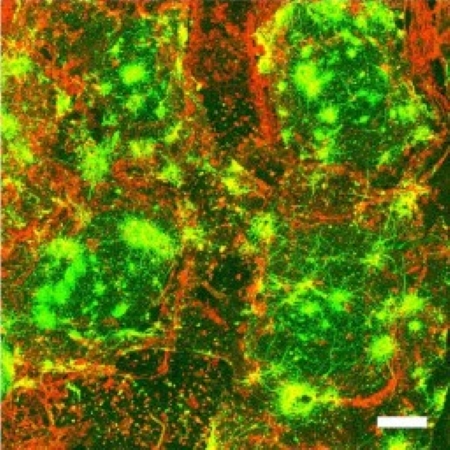
As always, Neuromics greatly appreciates when our products are used in publications. The most recent publication shared by customers took advantage of our mouse Tuj-1 antibody (Cat.#MO15013). In this publication, researchers describe how they created an ex vivo 3D vascularized neural constructs that mimics the function of the blood-brain barrier.
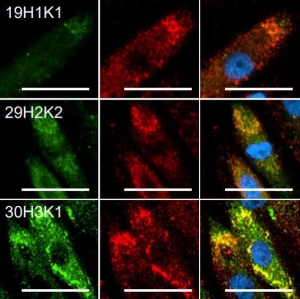
Image: The neurovascular interface containing Tuj1+ (green) neurons differentiated from NSCs (in spaces surrounding the vasculature network) and Claudin-5+ (red) endothelial cells (inside the microfluidic channels). Scale bar, 500 μm. Image citation below
Citation:
Haibing Yue, Kai Xie, Xianglin Ji, Bingzhe Xu, Chong Wang, and Peng Shi. (2020). Vascularized Neural Constructs for Ex-Vivo Reconstitution of Blood-Brain Barrier Function. Biomaterials. doi: 10.1016/j.biomaterials.2020.119980
Learn more...
Our Reagents are Helping Answer Questions About COVID-19
With COVID-19 affecting the globe for well over a year at this point, many researchers have shifted their focus to the virus. While there are many COVID-19 related questions still needing answers, it is incredible what the scientific community has achieved in such a short period of time.
Our reagents have been used by customers in a handful of publications that have helped us learn more about the virus. We've just added a new page to our website to compile all these publications. Visit it here.
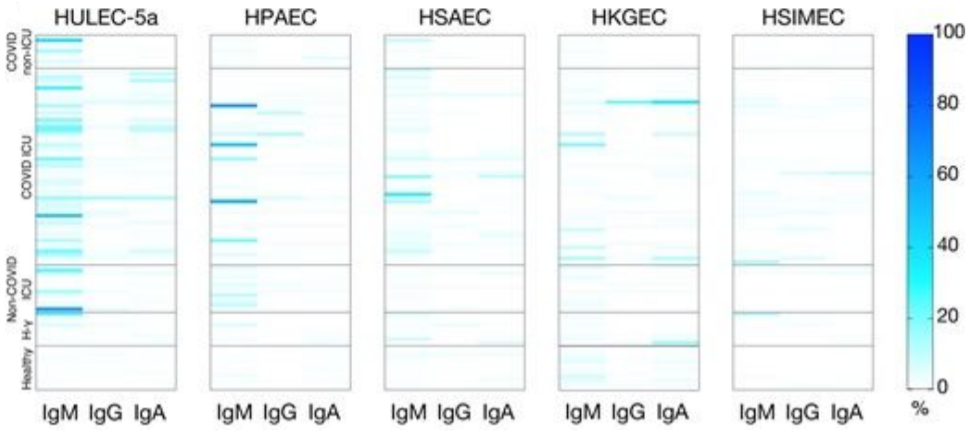
Image: Detected auto Ig levels in specific cell types, including our human small intestine endothelial cells.
Included is a publication from researchers at Emory University comparing the plasma of COVID-19 patients to healthy patients to study the pathogenesis of severe COVID-19. In this research, they used our Human Small Intestine Endothelial Cells (cat.# HEC15). Check out this blog post to learn more.
A second publication utilizes our Human Brain Microvascular Endothelial Cells (cat.# HEC02) to find a microRNA capable of targeting Neuropilin-1, a transmembrane glycoprotein that plays a role in the cellular entry of the SARs-CoV-2 virus. Learn more.